
A monument built for our defeat
On the ninth day of the Hebrew month of Av, the Jewish people still mourn the destruction of the Beit Hamikdash in Jerusalem. We remember the loss of our sacred center, the violence that accompanied it and the long displacement that followed.
Yet we observe this ancient day of mourning in a world transformed. Jerusalem is once again in Jewish hands. Hebrew is spoken as a living national language. The people Rome tried to scatter still endure.
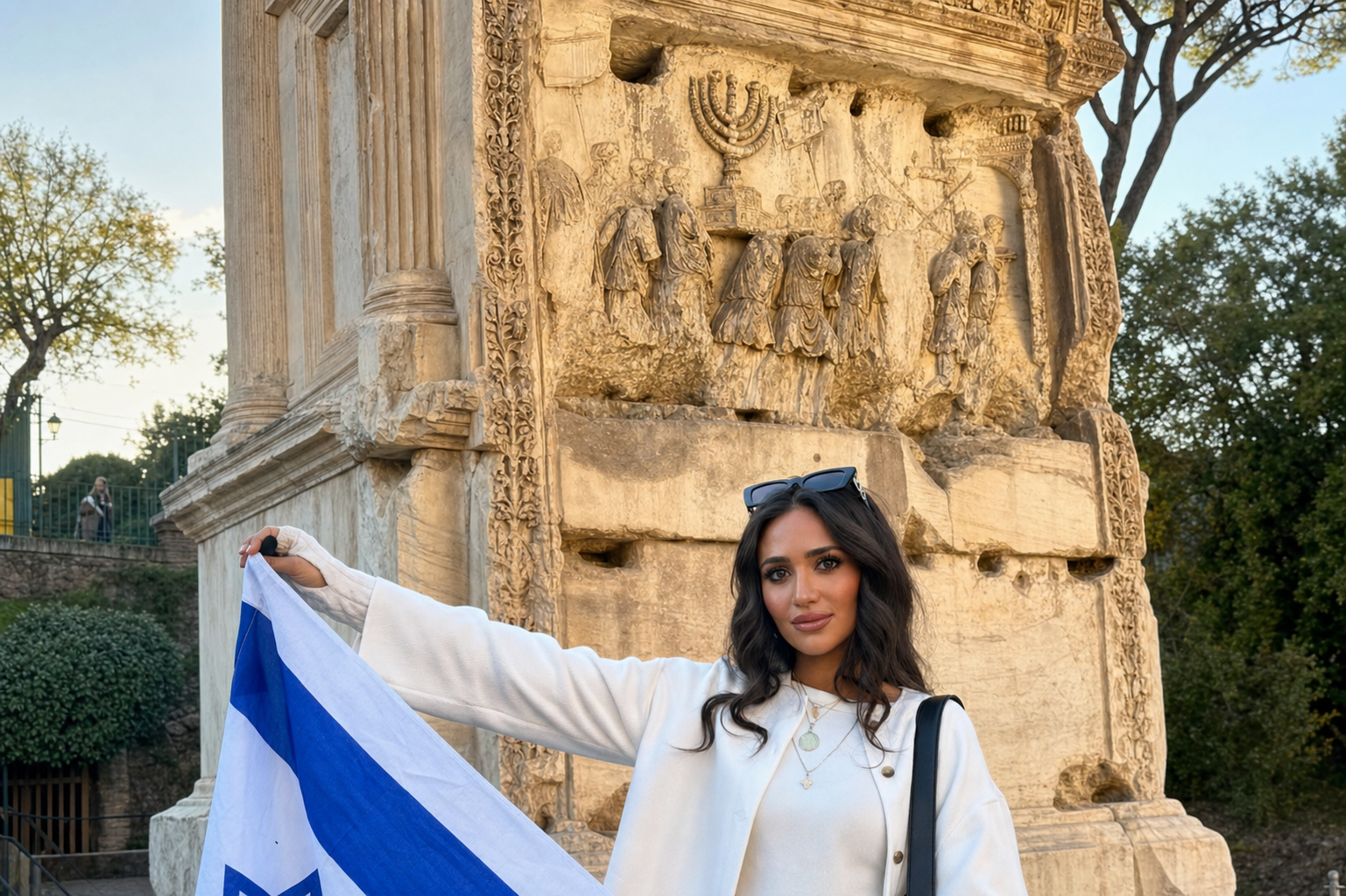
Few places make that contrast as visible as the Arch of Titus in Rome. Built to commemorate the Roman victory in Judea, the arch turned conquest into imperial propaganda. Its famous relief depicts Roman soldiers carrying sacred vessels from the Temple, including the menorah, through a triumphal procession. What was catastrophe for the Jewish people became spectacle for the empire.
Standing before the arch with an Israeli flag reverses the meaning Rome intended. The monument remains, but the empire that built it belongs to history. The Jewish people remain alive.
Rome carved our defeat into stone. Jewish survival gave the stone a different meaning.
What the menorah reveals
The menorah on the Arch of Titus is often treated as an artifact of Roman victory. For Jews, it is an image of violation: a sacred object removed from Jerusalem and displayed as the spoils of conquest. The figures beside it are not anonymous decorations. They represent the subjugation of a people whose land, sanctuary and political freedom had been attacked.
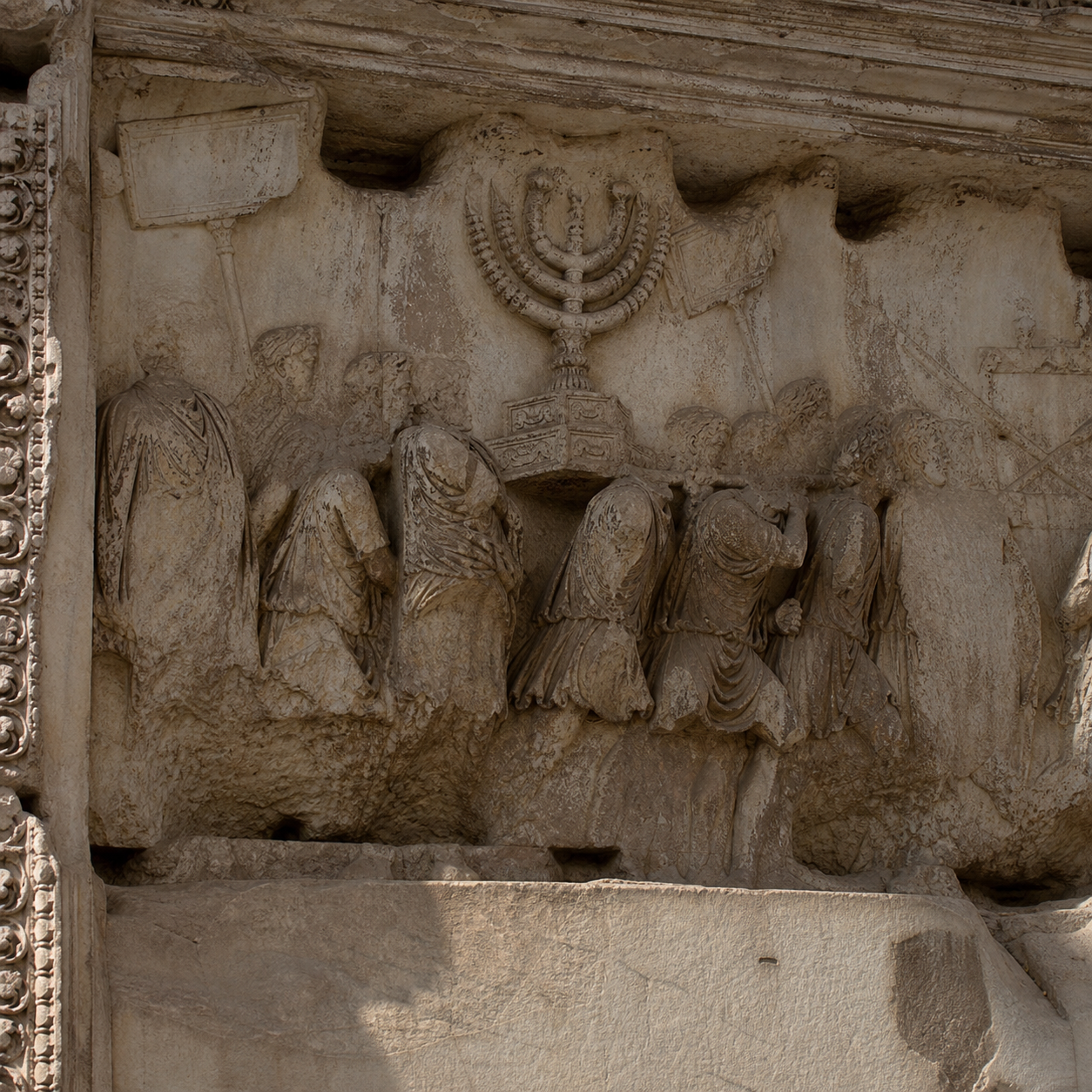
But the relief also preserves an unintended testimony. Rome needed to display the menorah because Judea possessed a civilization worth conquering: a people with its own sacred institutions, language, law, symbols and national center. The arch does not prove Jewish disappearance. It records Jewish presence.
The Roman triumph tried to tell a final story. Judea had rebelled, Rome had prevailed and the conquered would be absorbed into the empire. History refused that ending. Jewish communities carried the memory of Jerusalem across continents. They faced the city in prayer, mourned its destruction, preserved Hebrew and taught children that exile was a condition of history, not the origin of the Jewish people.
The captives are no longer captive
The Judean fighters and captives once paraded through Rome could not have imagined every chapter that would follow. They could not have seen Hebrew returning to streets and schools, Jewish sovereignty restored in the ancestral homeland or an Israeli flag raised in front of the monument that celebrated their defeat.
Yet those realities are part of their redemption. The language Rome expected to fade is spoken by millions. The calendar Rome tried to sever from the land still orders Jewish time. The menorah taken as plunder became an emblem of the modern State of Israel. The descendants of a scattered people can stand in Rome not as the property of an emperor, but as citizens of a sovereign Jewish state.
The flag does not erase the grief of Tisha B’Av. It shows that grief did not have the final word.
This is not a claim that every wound has healed or that sovereignty ends Jewish vulnerability. Israel faces danger, division and profound moral responsibilities. Jewish communities throughout the Diaspora continue to confront antisemitism. Redemption is not a reason for complacency. It is a call to become worthy of what earlier generations preserved for us.
From baseless hatred to baseless love
Jewish tradition associates the destruction of the Second Temple with sinat chinam, baseless hatred within the Jewish people. The teaching refuses to let memory become only an accusation against an external enemy. Rome destroyed Jerusalem, but our tradition also asks us to examine the fractures within our own community.
That question remains urgent. What good is restored sovereignty if Jews learn to despise one another? What does national revival mean if disagreement becomes dehumanization, if political camps treat each other as enemies or if the diversity of Jewish life is used as a reason for exclusion?
The answer to baseless hatred is ahavat chinam: a love that does not depend on total agreement, identical practice or shared politics. It is the discipline of recognizing one another as members of one people. Such love is not passive sentiment. It appears as responsibility, restraint, solidarity and the refusal to abandon one another.
The next stage of redemption will not be built by memory alone, but by what memory teaches us to repair.
Mourning with hope
Tisha B’Av asks us to sit with the brokenness of Jewish history. It does not ask us to deny the astonishing signs of renewal around us. We can mourn the Temple and still recognize the return to Jerusalem. We can remember the captives of Rome while celebrating Jewish freedom. We can grieve what was taken while giving thanks for what survived.
Standing at the Arch of Titus with the Israeli flag is therefore more than a gesture of defiance. It is a declaration that Roman power could destroy buildings, take captives and scatter communities, but it could not erase Jewish peoplehood. It could not extinguish Hebrew civilization. It could not prevent return.
Our redemption is unfinished. Its beginning can be seen in sovereignty, language and return; its fulfillment demands unity, justice, holiness and love. On this Tisha B’Av, may mourning deepen our gratitude, may survival strengthen our responsibility and may ahavat chinam bring us closer to the rebuilding for which generations have prayed, b’ezrat Hashem. 🇮🇱