
More than a Jewish Valentine’s Day
Tu B’Av is often introduced as the “Jewish Valentine’s Day.” The comparison is easy, especially in modern Israel, where the day has become associated with romance, weddings and expressions of love. But the fifteenth of Av carries a far older history and a far more collective meaning than a borrowed commercial holiday can hold.
Tu B’Av is a Hebrew date rooted in Jewish memory, the land of Israel and the repair of Jewish peoplehood. Its stories ask what becomes possible when barriers fall, mourning gives way to rebuilding and a divided people chooses to meet again.
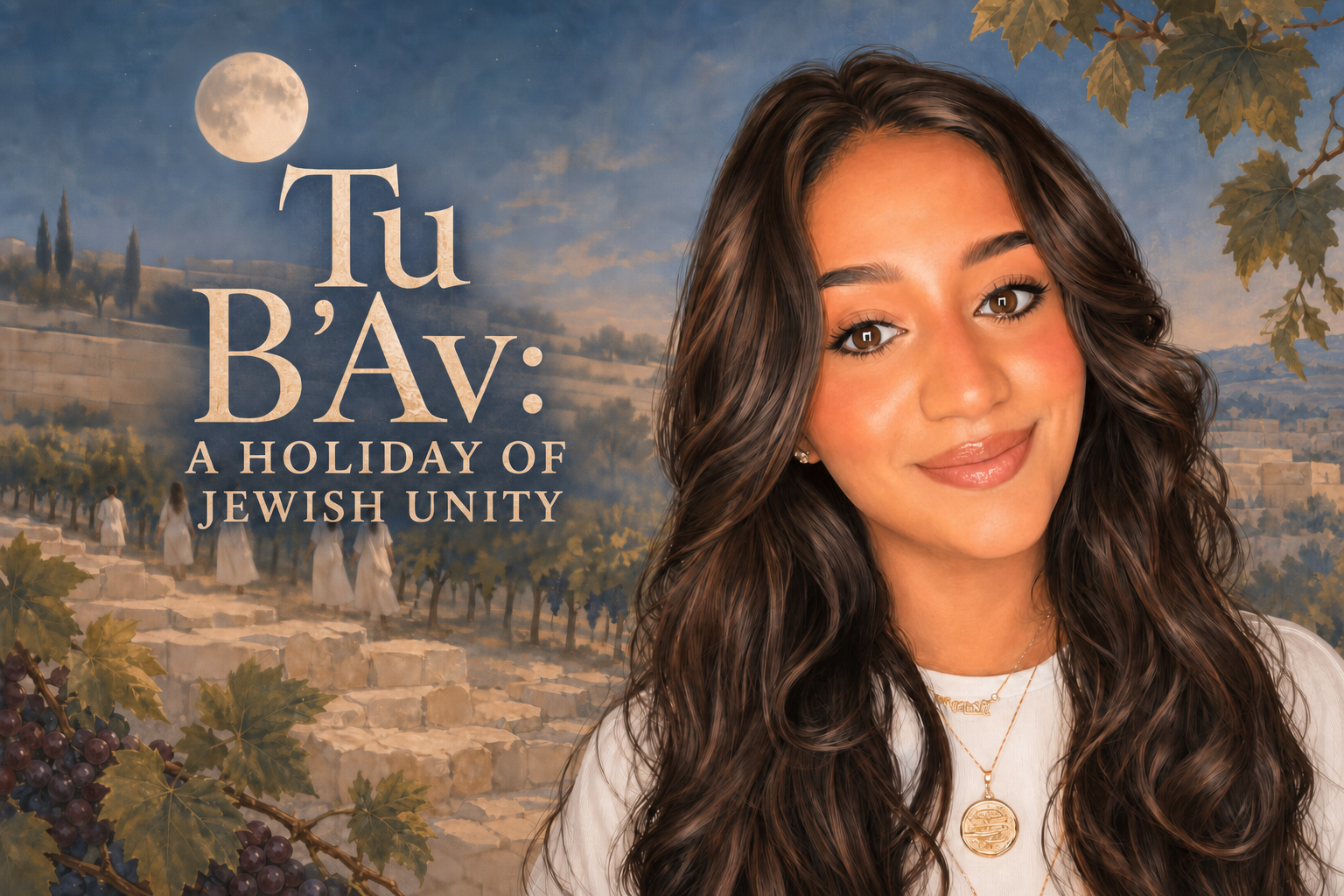
The Mishnah remembers Tu B’Av as one of Israel’s most joyful days. The daughters of Jerusalem would go out in borrowed white garments so that no one would be shamed by what she owned. They danced in the vineyards and called upon the young men to look beyond appearances and consider the character of the person before them.
There is romance in that scene, but it is not the romance of products, cards or a single idealized couple. It is a public ritual shaped by dignity, equality and the future of the community. Even the borrowed clothing carries a teaching: joy is not complete if someone must be humiliated to participate in it.
Tu B’Av asks us to understand love not only as feeling, but as the work of making belonging possible.
A date of restored relationship
The Talmud gathers several explanations for the joy of the fifteenth of Av. At first they can appear unrelated. Read together, however, they share a striking pattern: each story marks the loosening of a boundary that had separated Israelites from one another, from their land or from Jerusalem.
One tradition recalls the day on which the tribes were again permitted to marry across tribal lines. Another remembers the reintegration of the tribe of Benjamin after the devastating civil war described at the end of the Book of Judges. These are not uncomplicated love stories. They emerge from rupture, grief and decisions whose violence should not be romanticized. Their place in the memory of Tu B’Av points instead to a people refusing permanent fracture.
Unity in Jewish tradition does not mean pretending that conflict never happened. It means refusing to make division our final inheritance.
Another explanation remembers Hoshea ben Elah, king of the northern kingdom of Israel, removing the guards that had prevented his people from going up to Jerusalem. The road to the shared sacred center was opened again. Pilgrimage became possible. Jews who had been politically separated could once more direct themselves toward the same place.
That memory gives Tu B’Av a distinctly national and geographic meaning. The holiday’s unity is not abstract. It is oriented toward Jerusalem and toward the land in which Jewish collective life first took form.
From the wilderness into the land
Tu B’Av is also connected to the generation of the Exodus. According to rabbinic tradition, the dying of the wilderness generation finally ceased on the fifteenth of Av, signaling that the decree following the sin of the spies had reached its end.
The spies had looked at the land and surrendered to fear. Their report convinced the people that return was impossible. Tu B’Av therefore carries the memory of a threshold: the long sentence of wandering was ending, and a new generation could prepare to enter the land.
This is not a celebration of forgetting the failures of the past. It is the recognition that a people cannot remain forever trapped inside them. Forgiveness opens a future. The children do not have to reproduce the paralysis of their parents. Jewish time makes room for another beginning.
After the narrowness of fear, Tu B’Av restores the possibility of movement.
The martyrs of Betar
The most solemn tradition associated with the day concerns Betar, the final stronghold of the Bar Kokhba revolt against Rome. After the city fell, the dead were denied burial. Rabbinic tradition teaches that when permission was finally granted, the bodies had not decomposed. The blessing HaTov VeHaMeitiv, “the One who is good and does good,” was connected to both parts of the memory: the dead were preserved, and they were finally brought to burial.
The tradition is sometimes told with a specific number of years, but the classical Talmudic passage does not provide one. What it preserves is the cruelty of an empire that tried to control even the dignity of the dead, and the relief of a people finally permitted to honor its fallen.
Death touched the fighters of Betar, but Rome could not make them disposable. Jewish memory kept their dignity intact when imperial power tried to deny it. Tu B’Av does not turn their loss into triumph. It insists that burial, remembrance and collective gratitude are themselves acts of restoration.
The placement of Betar within a joyful day is deeply Jewish. Joy does not require amnesia. The calendar can carry martyrs and marriages, grief and vineyards, national rupture and renewed love on the same date.
Love as peoplehood
Tu B’Av arrives less than a week after Tisha B’Av. We move from mourning the destruction of Jerusalem and the consequences of sinat chinam, baseless hatred, to a day whose traditions repeatedly return us to connection.
That movement matters. The answer to Jewish division is not a shallow demand that everyone agree. Jewish unity has never required sameness. We carry different customs, histories, politics, languages and relationships to observance. Unity begins when those differences stop being excuses to abandon one another.
To celebrate Tu B’Av authentically is to ask more of love. Can it reopen a road to Jerusalem? Can it welcome a tribe back into the people? Can it give the dead their dignity? Can it make room in the vineyard for the person without wealth or status? Can it help a generation move beyond fear and toward the land?
This is the collective energy of the fifteenth of Av: not romance emptied of history, but love strong enough to repair history.
Going out to the vineyards
The women who danced in white did not wait inside for Jewish life to come to them. They went out into the open air, among the vines and toward one another. Their ritual joined land, season, dignity and the building of a shared future.
We can carry that spirit forward. Learn the stories behind the date. Honor the martyrs of Betar. Remember the opening of the road to Jerusalem. Refuse the fractures that tell us another Jew is beyond our concern. Celebrate romance, if that is part of your day, but let love grow wider than the couple.
Tu B’Av is a holiday of return: to our calendar, to our land, to Jerusalem and to one another. May the fifteenth of Av renew our commitment to Jewish unity, deepen our love for the land of Israel and give us the courage to build a peoplehood in which no one is left outside the vineyard.
Chag Tu B’Av sameach. ✨🇮🇱